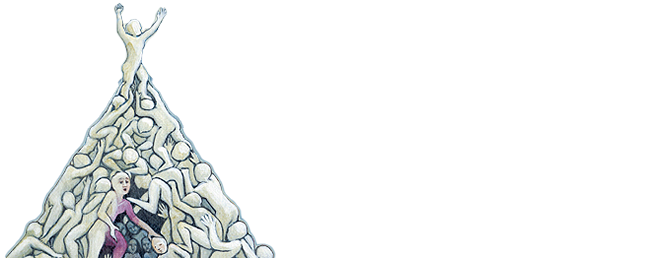
Hierarchical Profile
Howard, who works as a landscaper on the grounds of a manufacturing plant, is lower in the company hierarchy than people who work on production lines, but he is higher than people who are custodians. Howard is male and Asian American, so Howard is higher on the gender hierarchy than his female coworkers and is lower on the race hierarchy than White coworkers.

Since Howard is bald, tall, and slender, he feels lower than men with thick heads of hair, but he feels higher than men who are either shorter or heavier than society's hierarchical interpretation of the most desirable man. Howard has the use of ten fingers, so he is higher on the body hierarchy than his cousin born with three fewer fingers on one hand than on his other hand.
Howard chose his apartment carefully because Howard and his husband, Garie, are low on the sexual-orientation hierarchy. Garie is White and grew up in England, so his race and accent place him higher on the immigrant hierarchy than their neighbor from Mexico. Howard participates in a religious hierarchy in which he is lower than the clergy, but higher than people not of his faith.
A single mother raised Howard, so he felt his family was lower than the children of a married aunt and uncle. Howard went to a large high school in the city and remembers looking down on students from a small rural school. Howard inherited rental properties from his biological father, so he is higher on the wealth hierarchy than many people in his community.
What‘s Your Hierarchical Profile?
To build our own profile, we can begin with the lists above and rank ourselves high or low depending on each criterion. We may lie somewhere in between the extreme high or extreme low standards. Our rankings may change over time.
When we connect with another person within diverse groups, we are in higher and lower positions relative to each other. When we learn how to navigate through these roles, we ease the effects of everyday biases that can keep us apart.