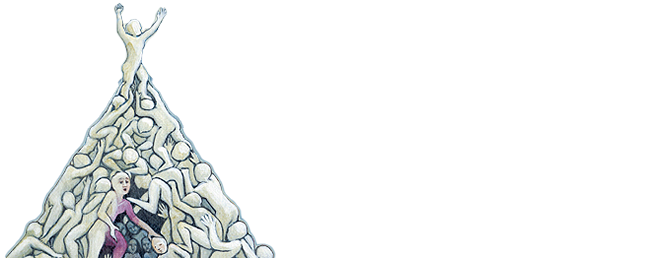
Clues
The common language of hierarchies is built upon “Clues” – predictable characteristics that are found in every hierarchy no matter who is on top or who is on the bottom. Clues uncover inequalities that can be elusive and hidden in plain sight.
Of the thirty-two Clues that have been identified, three are described below. The examples given with each Clue demonstrate that Clues describe the consistent attitudes and behaviors present in multiple hierarchies that might otherwise appear unrelated.

Clue #1:
More valuables flow to the top; what’s objectionable sinks to the bottom.
People who are on the higher levels of a hierarchy control and receive more of the rewards, opportunities, and incentives that are valued in that hierarchy. People in lower levels of a hierarchy receive fewer of the rewards, opportunities, and incentives, and more of whatever is not valued or even what is objectionable.
Examples:

Legislators pass huge tax cuts to benefit the rich which increase income inequality. They simultaneously cut the benefits of millions of people in the labor force whose work generates the money to pay for the tax breaks.
ICE agents approach two women who are both U.S. citizens. The white woman, originally from Canada, is not questioned while the brown woman, who immigrated from Mexico, is detained.
More than 80% of sports coverage in mainstream media follows men’s sports. The much lesser coverage of women’s sports shapes public perception – that women’s sports are less interesting or are not relevant enough to follow.
Clue #2:
People at the top know little about the people below even though people at the bottom know about the people above them.
People in high groups have the choice of whether or not to seek out or accept any true information about anyone lower. To survive among higher people, lower groups must learn about those above them and maneuver around the dictates from those on higher levels.
Examples:
Residents of a town know when Christmas comes around as they are immersed in its celebrations and festivities, but most Christians know little about other end-of-the-year or winter religious celebrations in their communities.
A boy with a purebred dog assumes that his friend with a dog from a shelter must not be able to afford a purebred dog because why else would his friend prefer a mixed breed dog.
A group of architects from the General Services Administration of the U.S. government all walk without assistive devices. They decide that a conveniently-located entry ramp is not necessary for a large new federal courthouse if one elevator around back is installed, also ignoring that sometimes it could be out of order.
Clue #3:
People at the top are not accountable for the effects on lower groups.
Those people in high positions are responsible for keeping power and control at the top and expect to have the freedom to act without factoring in the needs of lower people. Lower groups are expected to scramble and contort themselves to pick up the pieces that fall and make things work, no matter what problems and havoc the top creates.
Examples:
Cisgender heterosexual men are the group most likely to assault women. But instead of holding themselves accountable, they claim to protect women by passing "bathroom laws" that switch suspicion and blame to transgender women.
Christian nationalists promote themselves as the highest moral authority concerning everyone in the country. They ignore and justify the division, fear, and intolerance that they generate, promote, condone, and support against people not in their group.
A health care professional believes that Western medicine is the superior path to health. He works against passage of laws that would expand insurance coverage to include proven alternative medical practices.